



Oct 28, 2025 ITOCHU Techno-Solutions Corporation
ITOCHU Techno-Solutions Corporation (headquartered in Minato-ku, Tokyo; Tatsushi Shingu, President and CEO; hereinafter CTC) today announced the launch of re:Modern, our proprietary service designed to support the modernization (optimization) of legacy systems.
This service converts systems such as mainframes built using the legacy programming language COBOL into Java systems, leveraging migration support functions exclusively developed by CTC. The service is designed to support the operational phase in addition to code conversion, aiming to comprehensively help customers both in technical and operational challenges along every step, from requirements definition to maintenance and training.
In recent years, as companies accelerate their digital transformation (DX) initiatives, legacy systems have become a barrier to improving operational efficiency and flexibility. According to a report by Japan’s Ministry of Economy, Trade and Industry (METI)*¹, aging systems hinder system expansion and maintenance, and lead to talent shortages due to the aging and retirement of skilled engineers—ultimately resulting in a decline in corporate competitiveness. To address these challenges, there is a growing need for system modernization using the latest technologies, including migration to cloud-based and open systems.
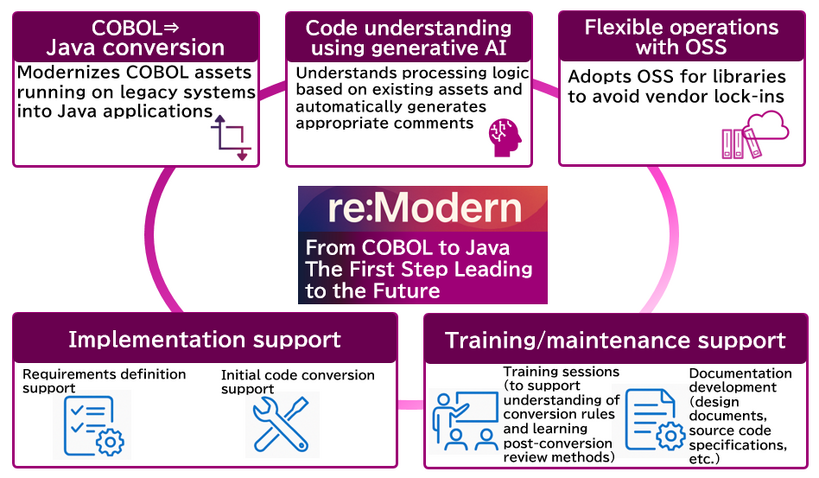
re:Modern is CTC’s proprietary service that automatically converts COBOL-based legacy assets into Java systems, which was developed by leveraging CTC’s extensive experience and proven track record in system integration and development. To significantly improve validity of the equivalence of COBOL and translated Java and overall work efficiency, the service incorporates generative AI capabilities that understand processing logic based on existing design documents and programs, and automatically generate appropriate comments for the converted code. This makes it easier for developers without specialized COBOL expertise to understand the transaction processes of existing systems, helping to eliminate dependency on specific expert individuals. In addition, the service provides capabilities such as comparing legacy and modern systems and supporting Java developers in understanding legacy system logic. These features can be effectively utilized during system rebuild initiatives—a development approach in which systems are reconstructed based on how existing systems were built.
For auxiliary functions (libraries) required after conversion to Java, the service adopts open-source software (OSS) with no restrictions, rather than relying on specific proprietary products. This enables the runtime environment to be freely selected and built, and allows for flexible operation and maintenance, helping to mitigate risks such as future end-of-support issues and vendor lock-ins.
In addition to requirements definition and code conversion, CTC also provides post-migration maintenance support and responds to technical inquiries during operation. Furthermore, CTC offers support for modernization along every step in both technical and educational perspectives including training sessions and documentation development designed to deepen understanding of conversion rules and learn review methodologies.
Going forward, CTC will continue to expand our support services on top of the conversion of legacy languages such as PL/I, RPG, and PL/SQL to include conversion to modern, cloud-ready languages including Node.js. In addition, CTC will advance version upgrades and migrations for open legacy*² systems, thereby continuously supporting the modernization efforts of a broader range of enterprises.
Illustrative Image of re:Modern, CTC’s Modernization Service
COBOL-to-Java Conversion Demo
https://www.ctc-g.co.jp/solutions/remodern/ (Japanese)
- *1According to the “Comprehensive Report Compiled by the Legacy Systems Modernization Committee” published by the Ministry of Economy, Trade and Industry (METI) on May 28, 2025, aging IT systems have been a major obstacle to the promotion of digital transformation (DX), which could potentially lead to serious negative impacts on corporate competitiveness and business continuity.
METI official page: https://www.meti.go.jp/english/press/2025/0528_001.html - *2Open legacy refers to systems that were built using widely adopted, standard technologies but have since become outdated. As these systems depend on obsolete technologies or architectures, it has become increasingly difficult to maintain, enhance, or modify them.
Contact Information
ITOCHU Techno-Solutions Corporation, Corporate Communications Dept.
E-mail:press@ctc-g.co.jp
Currently displayed information is correct at the time of the announcement. Please be aware that information displayed may differ from the very latest information.
