

- Official SNS
-

-


Natural Capital and Biodiversity Initiatives
Disclosures based on the TNFD Recommendations
In recent years, risks posed to the natural environment, such as the loss of natural capital and biodiversity, have been increasing, and their impacts on business activities have been expanding. The CTC Group endorsed the Taskforce on Nature-related Financial Disclosures (TNFD) recommendations and joined the TNFD Forum in June 2026. We aim to enhance our corporate value sustainably by properly understanding the relationship between our business activities and nature, taking appropriate actions and making appropriate disclosures in line with the TNFD recommendations.

Governance
We have established our sustainability promotion structure headed by the President & CEO. Decisions on important matters for nature-related issues are made by the Management Committee after being deliberated by the relevant departments, and are reported to, approved by and overseen by the Board of Directors. This structure is operated in an integrated manner with our responses to climate change and is part of our company-wide decision-making framework.
Respect for Human Rights in Nature-related Initiatives
We have established the CTC Group Human Rights Policy. We support international norms on human rights, including the International Bill of Human Rights and the Ten Principles of the United Nations Global Compact, and we will also promote measures for respecting human rights in alignment with the United Nations Guiding Principles on Business and Human Rights. In our nature-related initiatives as well, we are deepening our understanding of their connections with human rights issues, such as the rights of Indigenous Peoples and local communities. In addition, our Supply Chain Procurement Policy sets out respect for human rights, consideration for labor practices, reduction of environmental impacts and efficient use of resources, conservation of biodiversity, and non-use of conflict minerals, and we work together with suppliers in Japan and overseas toward the sustainable development of society.
CTC Group Human Rights Policy
The United Nations Global Compact
CTC Group Supply Chain Procurement Policy
Strategy
We have assessed and analyzed our dependencies and impacts of our business activities at business locations of CTC and its consolidated subsidiaries on natural capital, using international assessment tools such as ENCORE based on the LEAP approach recommended by TNFD. The results showed that our nature-related dependencies and impacts are relatively low, given the characteristics of our business, which is conducted mainly in offices and does not require large-scale land conversion. The analysis also confirmed that we have had no significant negative impacts on natural capital to date.
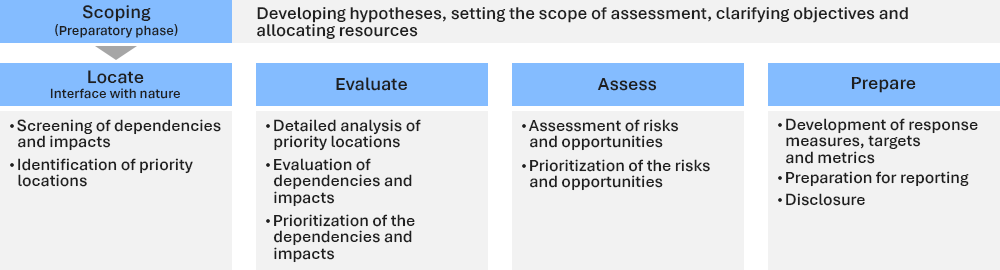
Assessment of Dependencies and Impacts
After organizing our business activities by sector and screening their dependencies on ecosystem services and their impacts on the environment, we have assessed them based on actual facts. Dependency on soil by our distribution and logistics centers was assessed as medium because ground stability and retention affect operational continuity. However, as these facilities are located in industrial zoning areas with the necessary groundworks laid, we have assessed that they pose no significant negative impact.
Assessment Results
| Dependencies on ecosystem services | Pressures (impact drivers) | |||||||||||||
|---|---|---|---|---|---|---|---|---|---|---|---|---|---|---|
| Provisioning services |
Regulating and maintenance services |
|||||||||||||
| Economic activity | Water supply | Soil and sediment retention |
Air filtration | Flood mitigation | Local climate regulation | Storm mitigation | Water flow regulation | Water use | GHG emissions | Non-GHG air pollutant emissions |
Emissions of toxic pollutants to soil and water |
Solid waste and disposal | Land use | Disturbances (e.g., noise, light) |
| Procurement of infrastructure-related equipment and hardware sales |
L | L | N/A | L | L | L | L | L | L | L | L | VL | L | L |
| Software development, system construction, implementation support, and maintenance/operation-related activities |
VL | VL | N/A | VL | L | VL | VL | L | L | VL | L | VL | L | L |
Data center operations and cloud services |
VL | VL | L | VL | L | VL | VL | L | L | VL | N/D | VL | L | L |
| Market research and public opinion polling | L | VL | N/A | VL | L | L | VL | L | VL | VL | VL | VL | L | VL |
BPO (business processes and outsourcing) |
VL | VL | N/A | VL | L | VL | VL | L | VL | VL | VL | VL | L | VL |
Service activities to support warehousing |
VL | L | VL | VL | L | L | VL | L | L | L | L | L | L | VL |
VH = Very high, H = High, M = Medium, L = Low, VL = Very low, N/D = No data, N/A = Not applicable
(Dependencies or impacts whose assessments of Low or above are shown; Those assessed as VL, N/D, or N/A are omitted.)
Assessments in bold: Assessments changed from ENCORE's default assessments based on actual conditions.
Risks and Opportunities Assessment and Response Measures
We have assessed risks and opportunities for business continuity from two perspectives—impact on our business and impact on stakeholders—as shown below.
Risks
| Category | Details | Response measures | |
|---|---|---|---|
| Physical | Acute | Risks arising from floods and inundation |
|
| Chronic | Increase of cooling loads (electricity cost) at data centers due to rising temperatures |
|
|
| Chronic | Increase of costs due to greater water stress at data centers |
|
|
| Transition | Regulatory Change | Increase of costs to comply with stricter regulations for purposes including greenhouse gas emissions reductions |
|
| Market/Reputation | Risk of delays in responding to customers' sustainability requirements |
|
|
Opportunities
| Category | Details | Response measures |
|---|---|---|
| Market/Products and services | Expansion of the market for environmentally conscious IT solutions |
|
| Market/Reputation | Enhancement of corporate brand value through the promotion of responsible business activities |
|
Metrics and Targets
The CTC Group's direct nature-related impacts and dependencies are limited. At the same time, climate change and natural capital/biodiversity are closely interrelated and greenhouse gas emissions constitute the principal impact the Group's businesses have on the environment. Therefore, we have set the reduction of greenhouse gas emissions (Scope 1 and 2) as our nature-related metrics and targets. These will be reviewed in a timely manner in response to changes in the business environment.
CTC Group Greenhouse Gas Emissions Reduction Targets (Base year: FY2022)
| Near-term targets | Scope 1 and 2:50% reduction by FY2030 |
|---|---|
| Long-term targets | Scope 1 and 2:90% reduction by FY2040 |
Aiming to accelerate Effective Utilization of Resources, the CTC Group continuously implements initiatives that contribute to reducing environmental impact and facilitating resource circulation, including shift to renewable energy, promotion of energy conservation, promotion of green procurement, going paperless, and thoroughly separating and recycling waste. We position these initiatives not only as our responses to climate change but also as those contributing to the conservation of natural capital and biodiversity.
Other Initiatives for Biodiversity Conservation
Support for Nature Conservation and Biodiversity Conservation Activities
The CTC Group supports initiatives for conservation of nature and biodiversity through donations and activity participations to champion causes of the following organizations: the WWF Japan Project for Biodiversity Conservation (made donations in September 2026), the Keidanren Nature Conservation Fund and the Chinjuno Mori (Forest of the Village Shrine) Project, a Public Interest Incorporated Foundation that conserves natural capital by growing forests that protect lives of people from natural disasters.
Tree-Planting Activities
The CTC Group employees engage in volunteer tree-planting activities, working to grow forests that help prevent and mitigate disasters and to conserve the environment.
Dialogue on Natural Capital and Biodiversity
In November 2025, we invited Shinkichi Mizutani, Secretary General of More Trees, a General Incorporated Association, for an in-house lecture on the theme of nature tech, and held a dialogue on how IT can contribute to establishing new relationships between urban life and forests in 2030.